
Shin Guards
Post-Synod 2026 Reflection #3

As I stood on the floor at Synod 2026 preparing to speak against the recommendation to appoint a new committee to study Reformed ecclesiology, two thoughts went through my mind:
This study doesn’t seem wise.
Jason Ruis is going to kick me in the shins for this.
Why No Ecclesiology Study?
So, knowing the righteous criticism that would fall upon me from out of the land of milk and cheese, why did I not support the recommendation for the study committee?
First, as I said on the floor, the study committee’s task was open to too much risk of change over time. According to Classis Wisconsin’s overture, one of the tasks of the committee would have been to “evaluate and synthesize” all the reports produced in the last five years that had something to do with the doctrine of the church. This would have included, at least:
The Assisted Suicide Task Force Report
The Church Order Review Task Force Report
The Appeals Process Task Force Report
The Virtual Church Task Force Report
The Multisite Church Task Force Report
The Task Force Report on Church Order Procedures to Discipline Officebearers
The Report of the Team to Clarify Distinctions in Synodical Pronouncements
The Task Force Report to Define Membership
Now, synthesizing these reports under a common theological framework is something that I can get behind theoretically. The problem is that Synods 2027-2030 are not going to stop making decisions or appointing study committees that have to do with ecclesiological matters. As a result, it seemed to me that, in order for the proposed study committee to do its job well, it would have had to continually reexamine and potentially update its work after each synod. If the committee failed to do that, it would have run the risk of missing important synodical decisions and studies which would have been critical to synod’s final evaluation of the committee’s work.
Second, as I said on the floor, part of the rationale for the study committee was that it would help us determine the type of church plants that the CRC should want to plant. The challenge here is that the report would take four years to complete which means that the CRCNA will be four years into planting churches before the committee report comes out. In that sense, the horse has already bolted out of the barn.
Some I’ve spoken to have replied that the CRCNA can walk and chew gum at the same time; that is, we can both plant churches and study the kinds of churches we want to plant. Granted. And I’ll admit that this was the weaker of the two arguments. But to offset it I would have had to have been persuaded that there was a good chance of the report turning out to be a report that we would want to get behind.
This last point leads me to my third reason for being a little wary of appointing a study committee. To state my opinion bluntly, its not clear to me that CRC study committees have done a wonderful job reflecting on Reformed ecclesiology over the last several decades. As everyone who was at synod knows, I have deep concerns about the last fifty years of synodical reports on church office. As a result, I was concerned that the recommended committee would have simply doubled down on what I suspect is a type of institutional drift. Maybe I’m being too conservative (I admit that it happens at times), but, as the saying goes, sometimes its better to be safe than sorry.
Finally, (on a much lighter note), I just don’t think that we need a synodical study committee to do this work. Let Classis Wisconsin take the initiative! Invite pastors and theologians from around the CRC to study the matter of Reformed ecclesiology. Reach out to neighboring classes to see if there is an interest in funding retreats and workshops to help church leaders think about and articulate a biblical, systematic, confessionally-faithful, Reformed ecclesiology. The upcoming Our Three Forms conference in October seems to indicate that this grassroots interest already exists. Let’s do our own homework. And, if we think its good, we can send it to synod as a communication or as part of an overture for further consideration.
Now, I admit that none of these arguments reach the conclusion that we shouldn’t have had a new study committee. If the synod body had voted to appoint the committee, I would not have lost sleep over it. At the end of the day, whether now was the right time to have this study was a matter of wisdom, stewardship, and administrative prudence.
On Getting Kicked In The Shins
As I predicted when I stood at the microphone, Jason gave me a little grief about speaking against the recommendation. He warned me that he would kick me in the shins a little on The Messy Reformation. I told him that was fine and that I probably deserved it. I enjoyed the episode and got a laugh out of it. He comes by his views honestly, as I hope I do mine. The main thing is that we both love the Christian Reformed Church and pray for its continued reformation.
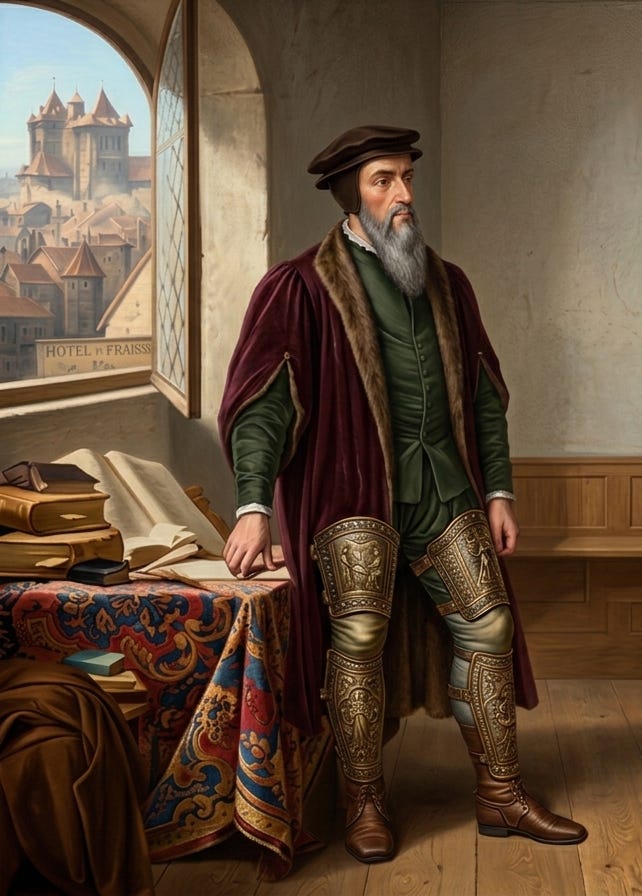
Also, it helps that The Confessing Calvinist always wears shin guards.
Coming in late here but mostly just to say thanks for your thoughts, Cedric. While I leaned in the other direction, I appreciate your perspectives.
Very good article, with a good sense of humor!