
Subscription
Reflections on Synod 2026 #2

“ He [i.e., an overseer, ἐπίσκοπος] must hold firm to the trustworthy word as taught, so that he may be able to give instruction in sound doctrine and also to rebuke those who contradict it.” - Titus 1:9
For the last five years, the Christian Reformed Church (CRC) has engaged in a thorough conversation about confessional subscription. Synods 2023, 2024, 2025, and now 2026 received numerous requests asking synod to clarify (or change) the CRC’s practice or expectations in this regard.
The conversation has focused on two questions:
Must a church member agree with all the doctrines contained in the confessions in order to become an officebearer in the CRC?
May an officebearer in the CRC who develops a serious, persistent, doubt or settled conviction contrary to the CRC’s confessions continue to serve without resolving those doubts or abandoning those conviction?
At the end of Synod 2026, here is where we stand:
1. The CRC requires its officebearers to affirm all the doctrines in the confessions
The last three synods have repeatedly affirmed that the CRC requires ‘full’ or ‘plenary’ subscription from those who would serve as officebearers. This means that, to become an officebearer in the CRC, a person must agree with all the doctrines contained in the ecumenical creeds, the Heidelberg Catechism, the Belgic Confession, and the Canons of Dordt. This is the standard set forth in the Covenant for Officebearers, our Liturgical Forms, and our Church Order. For example, according to the Covenant for Officebearers, officerbearers must affirm that the doctrines taught in the confessions “fully agree with the Word of God,” they must testify that they “heartily believe” these doctrines, and they must promise that they “will promote and defend [these] doctrines faithfully.” When a prospective officebearer stands before their congregations on the day of their ordination, they are required to say that they “subscribe to the doctrinal standards of the church, rejecting all teachings which contradict them.” And, if there were any further doubt, Church Order, Article 5, Supplement A.1 states that “The person signing the Covenant for Officebearers affirms without reservation all the doctrines contained in the creeds and confession of the church as being doctrines taught in the Word of God” (emphasis added).
So, the official answer to the first question is: Yes.
At the time that a person becomes an officebearer in the CRC, they must affirm that all the doctrines taught in the creeds and confessions are doctrines taught in the Word of God.
2. While the CRC requires its officebearers to affirm all the doctrines in the confessions, it allows them some flexibility when it comes to the firmness of that affirmation.
Both Synod 2025 and 2026 were largely concerned with answering what it means for a person to affirm all the doctrines contained in the confessions “without reservation” (Church Order, Art. 5, Supplement) or to do so “heartily” (Covenant for Officebearers). Many people over the last three years have wondered:
Does “without reservation” mean that a person has to know every doctrine contained in the confessions like the back of their hands?
Does “without reservation” mean that those who subscribe are saying that they believe all the doctrines with absolute certainty?
Does “without reservation” mean that a subscriber must never question or ever have even moments or periods of doubt?
Synods 2025 and 2026 were at pains to answer these and similar questions.
First, Synod 2025 clarified that a person always subscribes to the confessions to the best of their knowledge. We do not expect every person to have memorized Calvin’s Institutes of the Christian Religion. We don’t expect people to be able to wax eloquently on the fine distinctions of Trinitarian or Christological doctrine. What we expect is that someone will read through the confessions and, after having read them, be able to say, “Yes, given my understanding of Scripture, that sounds good to me.”
Second, both Synod 2025 and 2026 clarified that a subscriber does not need to have absolute confidence in every doctrine of the confessions before they can subscribe. Of course, this does not mean that they don’t have to have some level of confidence when they subscribe. At the very least, they need to have enough confidence to be able to stand before God and honestly affirm that the doctrine in question is a faithful summary of God’s Word.
Someone will inevitably ask at this point: but how do I know whether I have that requisite confidence? Or how do we as a council know whether someone has that requisite confidence?
In response to those questions, all I can do is give the following advice:
Pray
Talk about your concerns or questions with trusted leaders and wise mentors.
Reflect on Scripture together
Pray again
Listen to your consciences
Decide
We must remember that in life there are not specific rules for every situation. Sometimes (maybe even many times) what a situation calls for is wisdom: the judicious application of general principles to specific situations. Obviously, this does not mean we will always make the best or wisest choices. But thanks be to God! The gates of hell not prevailing against His Church doesn’t rest on our fallible discernment! And, if we come to discover that we have made a mistake, then there are processes for handling those mistakes with grace and truth (e.g., a confessional-difficulty gravamen or confessional-revision gravamen).
To put all this another way, there comes a point in the subscription process in which we simply need to trust that councils are going to do their due diligence and that our members are going to act with the integrity that Christ demands of them. Of course, fallen human beings that we are, this trust must also come with means to verify that people are not violating that trust. And we have those means. We have the gravamen process, we have the repeated re-affirmation of the Covenant for Officebearers at our classis and synod meetings, and if we are ever deeply concerned about the integrity of a brother or sister officebearer, we can address them and their council directly.
Finally, although Synods 2024, 2025, and 2026 clarified that a person at the time of subscription must affirm that all the doctrines contained in the confessions faithfully summarize God’s Word, these synods also recognized that after someone subscribes they will at times likely have wonderings, questions, concerns, and doubts. Building on the work done by Synod 2025, Synod 2026 sought to speak pastorally to this reality.
To help church members, officebearers, and councils navigate the process of discerning whether a doubt or concern rises to the level that would compromise a person’s subscription, Synod 2026 took the unprecedent step of adopting a picture:
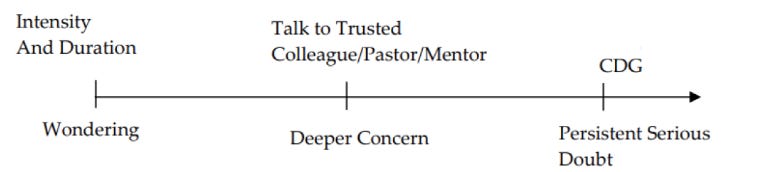
It should be remembered that this graph is a heuristic device and must be interpreted within the framework written out in the church order supplement to Article 5. So, for example, someone wrestling with a “deeper concern” who is asked to serve on council should not immediately conclude that because they only have a “deeper concern” and not a “persistent, serious doubt” that that means that they can subscribe. The church order is clear: at the time of subscription, a person must be able to affirm with a sufficient degree of confidence that all the doctrines contained in the confessions fully agree with the Word of God. A person asked to serve on council who has a “deeper concern” should disclose that to their council or pastor so that they can discern together whether they can subscribe with integrity. With that caveat, however, the picture/graph can be helpful, especially for people who are already serving as officebearers.
The main point of the graph is that there is usually a period of time over which an officebearer’s cognitive dissonance with a confessional teaching grows. During the time, as the intensity of the officebearer’s difficulty increases, the graph encourages officebearers to seek help. Nevertheless, even if an officebearer’s difficulty should rise to the level of a persistent, serious doubt, it should be remembered that a confessional-difficulty gravamen is not a punitive measure. It is a council-directed discipleship plan intended to support the officebearer so that they can have every reasonable opportunity to return to full convictional alignment with the confessions.
Conclusion
At the beginning of this post, I quoted from Titus 1:9 where the Apostle Paul tells Titus that an overseer “must hold firm to the trustworthy word as taught, so that he may be able to give instruction in sound doctrine and also to rebuke those who contradict it.” The ultimate purpose of the CRC’s practice of confessional subscription is to ensure that we live by that apostolic requirement.
Over the last three years, we in the CRC have wrestled hard with how to faithfully implement that part of Scripture in our denomination. In doing so, we have arrived at what I think are good answers to our original two questions.
On the one hand, we have made it abundantly clear that church members must agree with all the doctrines contained in the confessions in order to become an officebearers in the CRC. These doctrines are for us a summary of “the trustworthy word as taught” and, as the Apostle says, our officebearers should “hold firmly” to them.
On the other hand, we have acknowledged that, as we progress on our pilgrim journey to the New Jerusalem, we often struggle with doubts, anxieties, and fears. To account for that, the CRC over the last three years has developed firm, but deeply pastoral guidelines, to help officebearers resolve their doubts and concerns.
May the Lord bless our officebearers as they seek to grow in the wisdom and knowledge of Christ, and may all who who come behind us find us faithful.